
VideoOn Track
Track Day Prep Checklist: What to Check Before Every Event (Free PDF)
Ted's five checks before every track day, how to baseline MCS 3-way dampers before you leave, and a free printable checklist with a settings log.
Key takeaways
Applies to: Any car you take to a track day; the damper steps are for MCS 3-way dampers
- Baseline your MCS dampers before you get to the track, not in the paddock in the morning.
- Keep a notebook in the car or track bag and log your driving, tires and any suspension changes at every event.
- Check MCS canister pressures once a month or every couple of months, not before every track day.
- To baseline a knob, count the clicks all the way to minus, count back up the same number and confirm it in your notebook.
- Finish with a tire check, a clean windshield and wheel torque; center-lock wheels need the proper tool.
On this page 5
A good track day starts before you get to the track. In our new video, Ted walks through the routine he runs on his own cars before every event: keep a notebook, check the tires, baseline the MCS dampers, then give the car a good once-over. We turned that routine into a free printable checklist you can keep in your track bag.
What to check before every track day
This list assumes your car already gets its regularly scheduled maintenance and service. These are the checks Ted does on top of that, before every event.
- Keep a track notebook. Keep it in the car or in your track bag. At every event, note your driving, your tires and any suspension settings you changed that day. Ted's advice: be diligent about it, and you won't regret it.
- Check your tires. Put the car up on a rack or jack it up. Look for sidewall damage and anything picked up on the road: nails, screws, debris.
- Baseline your dampers. Do it before you get to the track to save time in the morning. The steps are below.
- Clean your windshield.
- Check wheel torque. On five-lug wheels, check the torque on each wheel. Center-lock wheels need the proper tool.
How to baseline MCS 3-way dampers
A baseline means counting every adjuster back to a known point and returning it to your setting. You start the day knowing exactly what the car is running, even if someone turned a knob and didn't write it down.
Canister pressure: monthly, not every event
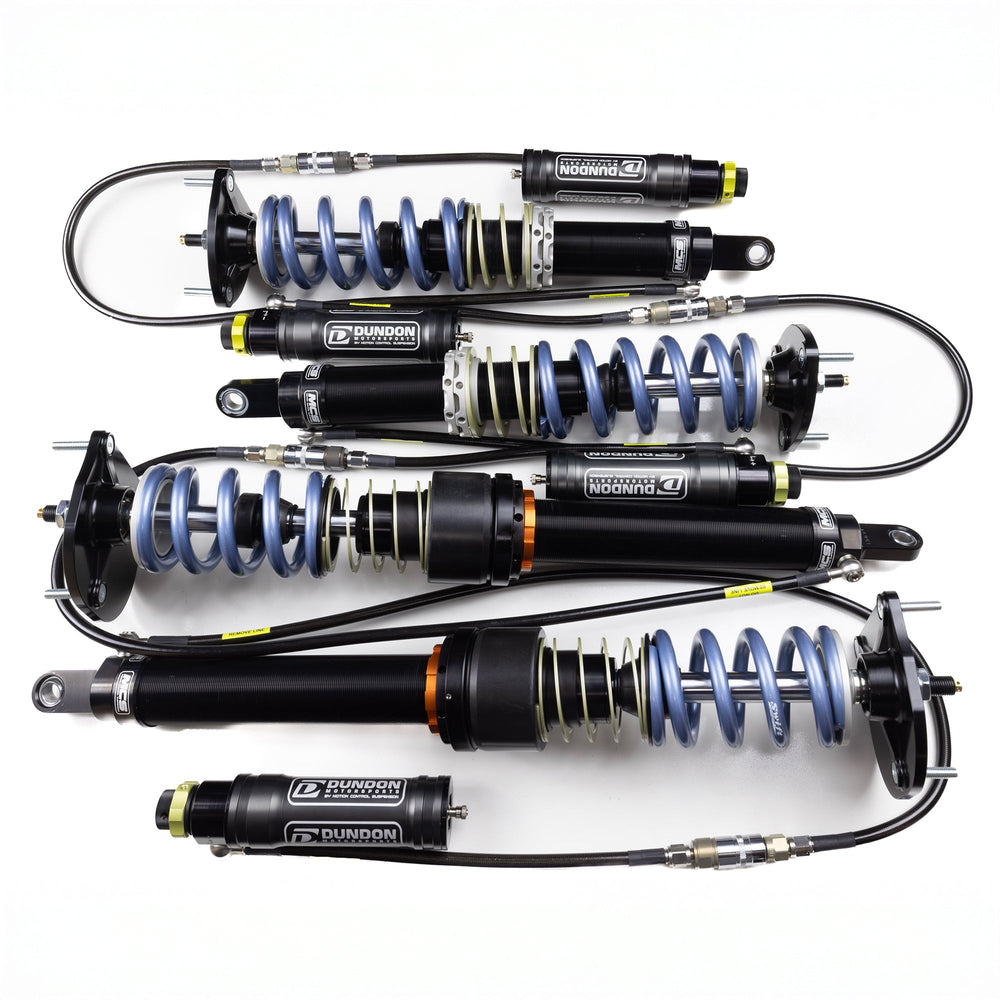
MCS 3-way dampers are pressurized with nitrogen through the Schrader valve on the end of the canister. Once a month, or every couple of months before you go to the track, pop the cap off, screw on the pressure gauge that comes with your MCS dampers, and read the pressure. Pressures are adjustable to fine-tune the car's balance, so confirm the reading against your notebook and note any change.
Keep the gauge in your track bag with your tire pressure and tire temp gauges, and you'll never misplace it.
Low-speed and high-speed compression
Both compression adjusters are on the canister. Low-speed is the small knob, with 10 positions. High-speed is the large knob, with 18 positions.
- Turn the knob all the way in the minus (−) direction, counting each click as you go. You can hear and feel each one.
- Count back up the same number of clicks to return the knob to where it was set.
- Confirm the setting in your notebook.
- Repeat on the other knob, turning in the same direction.
Rebound
The rebound adjuster is at the top of the damper. It comes with an extension and a knob so you can reach it inside the car, and it is marked + and −. Count it all the way back to minus, then reset it to the setting in your notebook. If it was changed and not noted, this is where you catch it.
Not sure what your settings should be? We have recommended settings for your car, so ask our team. New to MCS? Start with our guide to Porsche suspension packages and MCS 3-way dampers.
How we built the checklist
"What do I need to do to prep for a track day?" is one of the questions we hear most. So Ted filmed the routine he uses on his own cars, and we put the same steps, in the same order, on paper. Watch the video once at home, then work from the printout at the track.
The PDF has three parts:
- The checklist: five things to do before every track day, with tick boxes.
- Damper baseline: canister pressure, low- and high-speed compression and rebound, step by step.
- Settings log: date, track, tires and tire pressures, then canister pressure, compression and rebound for each corner, with room for driving notes. Three events per page.
Download the free track day prep checklist

Free PDF · 5 pages
Track Day Prep Checklist
The checklist, the MCS damper baseline and a settings log. Print it and keep it in your track bag.
Track day prep FAQ
How often should I check MCS canister pressure?
Not before every track day. Once a month, or every couple of months before you go to the track, is enough. Compare the reading with the pressures in your notebook.
What should I keep in my track bag?
Your notebook, the MCS canister pressure gauge, a tire pressure gauge and a tire temperature gauge, plus whatever you need to check wheel torque. Center-lock wheels need their own tool.
Free concierge call
Planning upgrades for your Porsche?
Tell us the car, the goal and the budget. A Porsche performance expert answers with a plan — no pressure.
Buying through a dealer? Ask them — they can book it too.

GuideOn Track
Porsche Suspension Packages Explained: Dundon Setup, Track Day & MCS 3-Way Guide
A detailed chassis-by-chassis guide to Dundon Porsche suspension setup packages, Track Day packages and Dundon-spec MCS 3-Way dampers for Carrera, Turbo, GT3, GT4, RS and Cup cars.

GuideAerodynamics
Real-World Test: 718 GT4 RS LabRat Performance Package Delivers 5-Second Gain at COTA
GT4 RS owner Barry Minor beat Randy Pobst's lap time at Circuit of the Americas with the Dundon Lab Rat package: suspension, aero, exhaust and alignment.

VideoAerodynamics
GT4RS Before and After
Stock vs upgraded 718 GT4 RS at The Ridge: lap times from three drivers with Dundon exhaust, MCS 3-way dampers, PFC brakes and Valkyrie aero, on video.